
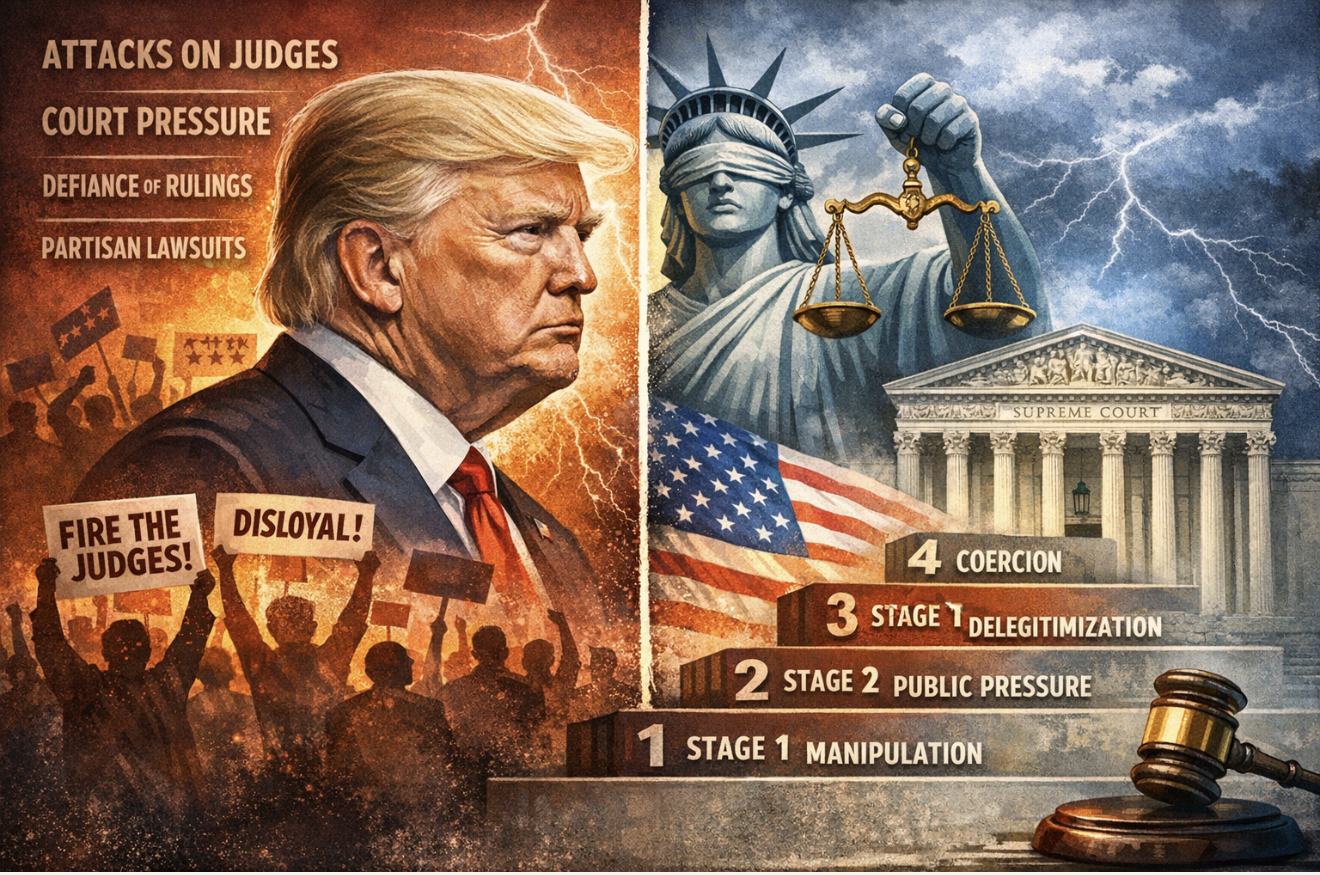
- From Washington to Berlin to Budapest, and the warning signs democracies ignore at their peril -
On April 1, 2026, the Supreme Court of The United States (SCOTUS) considered arguments on President Trump's executive order on whether almost anyone born on US soil is an US citizen. For this hearing, President Trump attended the oral arguments taking a front-row seat at the chamber's public seating area, making him the first sitting US president to attend a US Supreme Court hearing.
While some may see this as a sign of keen interest by President Trump in the oral arguments, many of us see this in a way expressed by an Associated Press article as "unheard-of flex of presidential power and prerogative". He spent ninety minutes in the court staring down the Justices of which three of the nine were directly appointed by President Trump himself.
After leaving the court, he went straight to his social media and posted: "We are the only Country in the World STUPID enough to allow 'Birthright' Citizenship!".
This singular action is in a way an act to intimidate Justices of the Supreme Court in their decision making as it concerns this case. This taken in consideration with similar acts by President Trump against the Justices, brings to fore similar acts of intimidation in the past, not just in the USA, but also elsewhere in the world, signaling a genuine fear of danger to our democracies which are dependent on a genuinely free and unencumbered judicial system that provides an oversight and limits the excesses of the executive arm of governments.
The tension between rulers and judges is as old as organized states. Every society that has attempted to restrain executive power through law has eventually confronted the same question:
What happens when the executive decides the judiciary is an obstacle rather than a partner?
From the Roman republic to modern constitutional democracies, leaders have used remarkably similar tactics to intimidate, weaken, or capture courts. The modern world often treats judicial independence as a settled principle, but history shows it is fragile, reversible, and dependent on political culture as much as legal text.
This article traces the long arc of judicial intimidation by the executive, showing how today’s conflicts echo centuries of precedent. It will start with a general and short historical reviews and then take us in a deep dive to where we are today with actions by President Trump intimidating the Judiciary. This will enable us to see a pattern, what stage we may be in the US, and project where this may take us if unchecked.
1. The Roman Republic: The First Recorded Executive Attacks on Courts
The pattern that emerged in the Roman Republic was the executive resisting legal limits when they were perceived as threats.
Roman magistrates often clashed with tribunals when judicial decisions constrained military or political ambitions. These consisted of consuls ignoring rulings, tribunes were threatened or exiled, and courts were bypassed through “emergency decrees”.
Rome established the template of executives’ tolerance for judicial independence only when it aligns with their interests.
2. Medieval England: Kings versus Judges
The English monarchy’s relationship with the judiciary was defined by conflict. It repeatedly attempted to intimidate or control judges. Examples include King Henry II putting pressure on ecclesiastical courts and famously clashed with Thomas Becket, King John retaliating against judges who resisted royal taxation, leading to the Magna carta’s insistence on lawful judgment, and the Tudor monarchs using the Start Chamber to discipline judges who deviated from royal expectations.
This made judicial independence not a gift but rather an entity that was extracted through conflict. This made judicial independence not a philosophical ideal but rather a battlefield.
1. British Empire: Judicial Subordination as Policy.
Across the colonies in Africa, Asia and the Caribbean, colonial governors routinely interfered with the judiciary by:
· The removal of judges who ruled against imperial interests.
· The manipulation of judicial appointments.
· The use of executive councils to override courts, and
· The suspension of judicial review during “emergencies”.
The idea of an independent judiciary was reserved for London, and not the colonial capital cities like Lagos, Delhi or Kingston.
2. French, Portuguese, and Belgian Empires.
These empires treated courts in the colonies and elsewhere in the empires as administrative tools with:
· Judges replaced, transferred or demoted for resisting colonial directives.
· Legal systems were designed to enforce assimilation, not justice and were sometimes used to blackmail those seen as opponents of the empires.
· Executive decrees superseded judicial rulings.
3. Post-colonial Legacy
After independence most of the old colonies as newly independent nations inherited existing “ways things were done” including:
· Weak traditions of judicial autonomy.
· Executive dominated judicial structures and operations.
· Legal cultures shaped by authoritarian colonial administration.
These inherited legacy from colonial masters shaped judicial-executive relations for examples in Nigeria, Kenya, Uganda, India, Pakistan, and beyond in many other countries in Africa, Asia and Latin America.
Across continents and centuries, executives have attacked courts and followed a predictable sequence. These stages are not theoretical but are rather observable patterns.
Stage 1: Delegitimization
This involves the executive publicly attacking judges as biased, corrupt, partisan, or tagged as “enemies of the people.”
Stage 2: Public Pressure
There is coordinated media campaigns, rallies, and speeches with intent to intimidate the courts.
Stage 3: Institutional Manipulation
This is implemented by political leaders attempt to change the rules by:
· Court-packing
· Jurisdiction stripping
· Forced retirements
· Appointment manipulations
· Budgetary pressure
Stage 4: Coercion
This entails direct intimidation of the judges who are made to face:
· Investigations
· Surveillance
· Arrests
· Threats
· Removal proceedings including impeachment
Stage 5: Full Capture
This is a stage where the judiciary becomes an extension of the executive and made to carry out all the biddings of the executive with no resistance.
With the above five stages, a framework exists for us to compare nations across time and political systems and to take a deeper look at project 2025 and President Trump’s intimidation tactics.
1. Nazi Germany: The Template of Total Judicial Subordination
This a clear example of Stage 5: Total Capture.
This was created by Hitler moving very rapidly by:
· The purge of “unreliable” judges.
· The creation of special courts outside the normal existing court systems.
· The requirement of judicial loyalty oaths by the judges to be able to remain within the court systems.
· The elimination of judicial review which is fundamental in any legal process in maintaining full due process with justice and equity.
Since the collapse of the Third Reich, there have been many examples of countries that have replicated this mostly after military coups in Low-Middle Income Countries. But this is being copied gradually or movement in this direction as will be pointed to later.
2. Soviet Union and Russia
This represents long-term, stable judicial capture.
In the Soviet Union era under Stalin, judges were treated as political instruments with show trials replacing legal process.
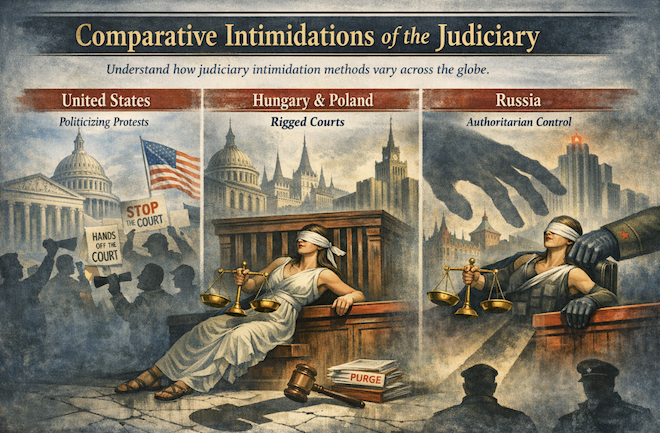
In modern Russia under Putin, courts were made to validate executive decisions and legalizing or normalizing illegal actions by the executives. The opposition figures were made to face predictable outcomes through the legal system that were against due legal process. Also, constitutional changes were made to extend presidential power including extension of how many times Putin could contest re-election.
3. Turkey: Erdogan’s Post-Coup Purges
Turkey is a textbook example and a Stage 5 case.
Erdogan used the chaos of a 2016 coup attempt to effect changes that undermined the judiciary and empowered him to go after the opposition and even citizens.
This included more than 4,000 judges and prosecutors dismissed or arrested. New courts were created under executive control to implement executive agenda and undermine constitutional essence and rights. The judicial councils were also restructured to align them with the executive plans and initiatives.
4. Hungary: Orban’s Systematic Legal Engineering
Hungary sits at the Stage 4-5, a transition that intend to get it to Stage 5.
Orban’s government took steps in this direction by lowering retirement ages that enabled him to purge senior judges. This was followed by his packing the courts with his loyalists while also creating new administrative courts under executive influence. This has led to decisions by those courts in favor of the executive. This included challenges to rigged elections or imprisonment of opposition politicians.
5. Poland: The disciplinary Chamber Model
This is a Stage 3-4 example.
The Law and Justice Party (Prawo I Sprawiedliwosc - PiS for short) is the populist, conservative political party of the then ruling executive (but now in opposition since 2023) in Poland took steps in this direction by politicizing judicial appointments. It also created a disciplinary chamber to punish non-conforming judges. It also forced early retirements of the judges.
While the new coalition government in Poland led by Donald Tusk did not “inherit” the above judicial changes, it faced several obstacles in changing them. This is because attempts in initiating broad reforms to restore rule of law were blocked by a PiS-aligned President.
6. The Philippines: Marcos and Martial Law.
This is another case of Stage 5.
In this case, Ferdinand Marcos removed judges, created compliant courts, and used the judiciary to legitimize authoritarian rule. Most of what he did was through a martial law (Martial Law Proclamation 1081) from 1972 to 1986 and forced this by destroying the autonomy of the judiciary, creating military tribunals to replace civil courts while putting his loyalists in the Supreme Court while in the process forcing the existing 14 supreme Court justices to resign in 1982.
He accumulated absolute authority over the judiciary which created a culture of fear and obedience within the judiciary, and rendering the judiciary inability to challenge him while enabling him untethered violations of human rights with impunity.
7. Latin America: Courts under Military Rule
This is another case of Stage 5.
It follows the pattern like Marco’s Philippines especially in Argentina, Chile and Brazil where courts were sideline and military tribunals replaced civilian courts. Judges who resisted were removed or threatened.
This created an environment where human rights were severely abused with stories of abductions and summary executions like the instance of Pinochet’s Chile.
In most of the countries, judicial intimidation was structural and not episodic.
8. Africa: Post-Colonial Executives and the Courts
The Stages varied but bordering at Stages 4-5 in most instances especially under the military regimes.
Across Nigeria, Kenya, Uganda, Ghana (Pre-1990s), and others, there were structural foundations with military regimes suspending courts, creation decrees that ousted judicial review. This also involved judges being transferred, intimidated or removed.
In some instances, judges were abducted and assassinated as it was during Idi Amin’s time in Uganda.
Even in democratic periods, elected executives on many instances tested judicial boundaries using the templates from past military regimes or colonial masters.
Nigeria’s judicial history is inseparable from its military past especially with the most recent constitution created during the military time and fine-tuned to meet the desire of the then military government.
1. Military Decrees and the Suspension of Judicial Review
From 1966 to 1999 (with brief interruptions), the military regimes:
· Suspended constitutional courts.
· Replaced judicial review with decrees.
· Created special tribunals.
· Removed or transferred judge who resisted.
Despite all these, the judiciary survived but independence was severely weakened with judges becoming more corrupt with ruling being made “for sales” to highest bidder.
2. The Fourth Republic: Independence on Paper, Pressure in Practice.
During this period, Nigeria oscillated between Stage 2 and Stage 3.
The fourth republic brought in a new era after the Abacha authoritarian regime, which was military dictatorship at its worst with opposition hounded, imprisoned and assassinated with many going on exile while the winner of a presidential election was put in jail.
Since 1999, the executives have criticized courts over election rulings with judges arrested or investigated. This also involved security agencies raiding judges’ homes. Also, the appointment process for judges remained politically influenced. Cases involving government’s appearance in court tends to involve intimidation or bribery, a case of carrot and stick.
It is unlikely that this will change soon as this has been normalized and acceptable within the general society.
3. Structural Weaknesses
This has created vulnerabilities that make judicial intimidation easier and include:
· Underfunding
· Executive-dominated judicial councils.
· Politicized appointments.
· Creation of public distrust in the judiciary.
1. Andrew Jackson
This is an example of Stage 2.
The defiance of Worcester v. Georgia by Andrew Jackson in 1832 remains the most famous example of executive disregard. In this case, Jackson refused to enforce the ruling that was favorable to the Cherokee Nation in which Chief Justice John Marshall ruled Cherokee lands as sovereign not subjugated to Georgia laws, and in the process undermining judicial authority which enabled Georgia to ignore federal court rulings.
It was reported that Jackson stated, “John Marshall has made his decision, now let him enforce it.” This singular statement tried to emphasize that the executive branch holds equal power to interpret the US constitution with no basis to follow decisions from the court. His statement was followed by his action using the Army to remove Cherokee residents forcefully.
Jackson’s action pointed to a significant instance when the executive showed a defiance to a ruling from the federal courts.
2. Abraham Lincoln
This is another example of Stage 2.
Most of Lincoln’s actions occurred during the Civil War which may be understandable based on the circumstances.
His actions intimidated the judiciary in the suspension of the Habeas Corpus without congressional approval. This was in a case Ex Parte Merryman in 1861 with Chief Justice Roger Taney’s ruling. He defied Supreme Court rulings and went further to restructure the federal courts to enforce loyalty. His ignoring judicial orders was also associated with arrest of critics while promoting that the combination of the executive and the legislative branches of government were the “people” (elected by them) and therefore superior to court rulings.
Lincoln also authorized military arrests of civilians, politicians and journalist with a direct challenge to the civil court system. His other actions included the reorganization of federal court circuits while also adding a tenth Supreme Court Justice which allowed him to appoint pro-Union judges. He also stated, “The people of these United States are the rightful masters of both Congresses and Courts.” This statement was made to emphasize and promote a doctrine that the Supreme Court’s decisions were not bindingly supreme over the political branches of government.
Why I pointed to all these being understandable as they occurred during the civil war is because many people also believed that such extraordinary executive power was a necessity (under Legal Doctrine of Necessity or Jus Necessitatis) that had set aside legal constraints during the war.
3. Franklin Roosevelt
The 1937 “court-packing plan” (Judicial Procedures Reform Bill) was the closest the US came to Stage 3.
The bill proposed to add up to six new Justices to the Supreme Court with the aim of overcoming the conservative opposition to his New Deal Legislation. It was framed to increase efficiency in the Supreme Court by allowing the President to appoint a new justice for every sitting justice of the SCOTUS over 70.5 years old who did not retire but with a hidden agenda of replacing conservative justices with liberals who were friendly to the New Deal program. This was met with a significant political backlash and the plan eventually failed.
He was also using public rhetoric and pressure by publicly criticizing the Supreme Court as being out of touch and not understanding modern economic and social problems of the American public.
Despite the failure of the bill, there was an effect of the threat of reorganization intimidating the court in stepping back from its stance on many key issues which was exemplified by Justice Owen Roberts’ switch of his earlier vote to uphold minimum wage laws.
The consequence of all these was also the later retirement of conservative Justice Van Devanter and enabling Roosevelt to make multiple appointments thereafter which led to court’s complying with his intentions as stated in his legislative agenda. While the bill never saw the light of the day, Roosevelt succeeded by his intimidation with the court becoming more accommodating to his policies.
In recent decades, we have seen increasing public attacks on judges, claims of illegitimacy and calls for impeachment over rulings.
The US has not yet crossed into structural manipulations. This is because of existing and inherent strong legal culture, lifetime appointments, federalism, independent bar associations and medial scrutiny. These guardrails are cultural as much as constitutional.
Trump during this second term has fine-tuned some of what was done in the past (historically) to meet his own desire to control the judiciary using all the intimidating tactics that will go against the cultural values and the constitution.
The five-stage framework developed earlier in this article provides a structured way to evaluate how modern executives interact with the judiciary. Applying that framework to the presidency of Donald Trump, across both his first and second terms, reveals a pattern of escalating conflict between the executive branch and the courts, with actions that map onto several of the early and mid-range stages of judicial intimidation.
This section does not offer political judgment. Instead, it situates documented events within the same analytical structure used for Hungary, Poland, Turkey, Russia, and other global cases.
Stage 1: Delegitimization: Public Attacks on the Judicial Credibility
Across both terms, Trump has repeatedly criticized judicial decisions and individual judges. Public statements have included claims that courts were acting politically or unfairly when ruling against executive actions. This pattern is consistent with Stage 1, where leaders frame the judiciary as biased or obstructive.
Examples include:
· Statements questioning the motives of judges who issues injunctions against executive orders.
· Comments describing certain rulings as partisans or illegitimate
· Public criticisms of judges who ruled against administration policies. This included targeting specific judges such as Gonzalo Curiel, James Robart, and Tanya Chutkan, mostly with allegation of political bias and sometimes referring to judge Jon Tigar as “Obama Judge”.
· Aggressive rhetorics were mostly used to intimidate the judges especially those who ruled against his policies by calling them lunatics, disgraces, crooked or monsters. He is known to frequently label judges as “radical left lunatics” and sometime accusing the judges of being “on a mission to keep murders, drug dealers, rapists” roaming free.
· The method of public personal attacks against family members of judges presiding over the case, for example that of Justice Juan Merchan.
Stage 2: Public Pressure by Direct and Symbolic Pressure on the Courts
The Stage 2 involves using public platforms, media, or symbolic gestures to pressure courts. During Trump’s second term, one notable example was his physical attendance at a Supreme Court hearing on birthright citizenship on April 1, 2026, which was an unprecedented act in modern presidential history.
According to reporting, Trump arrived at the Court after publicly accusing some justices, including those that he appointed, of being “disloyal” for previous rulings. He contrasted them with liberal justices, whom he described as predictably opposed to him, and suggested that conservative justices were trying too hard to appear “honorable” by ruling against him. And these comments were widely interpreted as an attempt to influence or intimidate the Court.
Presidential attendance at Supreme Court oral arguments is very rare and historically avoided to preserve separation of powers. The combination of attendance and pointed public commentary fits the pattern of Stage 2 public pressure.
Other prior instances of Supreme Court pressure existed when he called for the resignation of Justice Ginsburg and referring to justices that were appointed by Republican presidents as “Republican Judges” and termed them as lapdogs and fools.
He has also in the past used political pressure by demanding that Congress should “crack down” on “rogue judges” while also starting lawsuits against judges to force their recusing themselves from some of his cases.
Stage 3: Institutional Manipulation: Attempts to Influence Judicial Process
The Stage 3 involves efforts to alter judicial structures, processes, or professional incentives. While the US system’s constitutional design limits the executive’s ability to restructure the judiciary, several documented actions during Trump’s presidency fall into this category and includes:
1. Executive branch resistance to court orders
Reports indicate that the administration, at times, did not fully comply with certain judicial orders, or delayed compliance. In the first six months of Trump 2.0 administration, courts in at least 12 cases found violations of court orders.
This has been a pattern of frequently engaging in legalistic non-compliance while criticizing the authority of lower courts in issuing nationwide injunctions.
2. Public suggestions that judge who ruled against the administration should be removed
Statements by senior officials, including the Vice-president, calling for removal of judges who issued adverse rulings against Trump administration, creating a type of institutional pressure.
3. Litigation targeting the judiciary or legal profession
The Department of Justice has filed unprecedented lawsuits against every judge on the District Court of Maryland over a deportation freeze ruling. It has also initiated suits against members of the legal profession as an intimidation tactic.
4. Executive orders affecting law firms
The American Bar Association (ABA) filed suit alleging that certain executive orders created a “law firm intimidation policy,” limiting law firms’ ability to take cases that involve challenges to Trump administration policies. A federal judge found the allegations plausible and allowed the case to proceed.
All the above actions do not constitute structural manipulation on the scale of Hungary or Poland, but they do reflect attempts by the Trump administration to influence judicial behavior through institutional pressure consistent with Stage 3.
Stage 4: Coercion – Investigations, Threats, or Punitive Actions.
Now, there is no evidence of systematic coercion of judges in the US comparable to Turkey’s post-coup purges or Russia’s political prosecutions.
But certain actions approach the lower boundary of Stage 4:
· Although the lawsuit targeting an entire federal district court was technically lawful, its scope was unmatched, and some analysts viewed it as a retaliatory move against judicial scrutiny.
· The ABA alleges that executive orders were employed to penalize or intimidate law firms representing clients in actions opposing the administration, indicating pressure on the wider legal community, though not directly on the judiciary.
These actions do not rise to the level of coercion seen in authoritarian systems, but they represent pressure tactics that exceed typical executive-judicial friction in US history. This follows a pattern of slow creep by authoritarian regime towards attaining a full control of the judiciary.
I see these as very worrisome and evidence of intent by the Trump administration for a full creep into Stage 4 and likely further into Stage 5.
Stage 5: Full Capture – Not yet applicable in the US Context
For now, there is no evidence of judicial capture in the United States comparable to:
· Hungary’s forced retirements.
· Poland’s disciplinary chambers.
· Turkey’s mass arrests.
· Russia political courts.
· Nigeria’s coerced judiciary through bribery and corruption, and appointments by tokenism.
The US judiciary remains structurally independent, with lifetime appointments, decentralized power, and strong institutional norms. But as stated above, there is always fear of a slow creep into this stage with a weak link in bribery and corruption and possibly also blackmailing. This type of tactic could lead to the SCOTUS justices conforming to the desire of the executives.
In global context, the US under Trump aligns most closely with Stages 1-3 with possible slow creep into Stage 4, like early-stage judicial conflicts in other democracies, but far from the structural capture seen in Hungary, Poland, Turkey or Russia.
Judicial independence is not a natural state as it is a political achievement that must be defended. Executives whether democratic or authoritarian, tend to see courts as obstacles when:
· Elections are contested.
· Policies face legal challenges.
· Corruption investigation loom.
· Opposition gains momentum
This makes the temptation to intimidate courts to be universal.
The US example illustrates a key lesson from global history:
“Judicial intimidation does not begin with structural reforms, as it begins with rhetorics, symbolism and pressure.”
The early stages are subtle, often legal, and frequently justified as political disagreement. But they can escalate if institutional guardrails weaken. The US system’s resilience includes lifetime tenure, decentralized courts, strong bar associations, and a culture of judicial independence, which have so far prevented escalation beyond Stage 3.
But the global record shows that no system is immune if political norms are eroded.
History has taught one very clear lesson:
“Judicial independence survives only when society refuses to tolerate its erosion.”
No constitution, no matter how well written, can protect courts if political culture collapses. Conversely, even weak constitutions can sustain judicial independence when norms are strong.
The struggle between law and power is eternal, but so is the human insistence that justice must stand above all rulers.
Therefore, the responsibility lies with us, the people. We, the people, should resist any form of judicial intimidation.
The current Trump government is using every tactic in the textbook of judicial intimidation, and the country may be moving from prior attained Stage 2 towards Stage 3 and further as it is even creeping abet slowly into Stage 4.
This is why some of us will continue to speak out loud and bring this out into open discussion in a clear and distinct manner of understanding and analysis to the public.
--------------------------------
Dr. Segun Toyin Dawodu is the owner and chief webmaster of Dawodu.com. He has a medical degree from University of Ibadan, MBA from Johns Hopkins University Carey Business School, MSc in Global Health Leadership from University of Oxford, LL.B from University of London, MS in Clinical Informatics from Northwestern University, Evanston, IL, LL.M in Medical ethics/Intellectual property law from University of London, LL.M in International Corporate and Commercial Law from Kings’ College, London, LL.M in US law from George Mason University, Postgraduate Diploma in Economics of Law/Competition Law/Antitrust Law from King’s College, London, Creative Writing Diploma from University of Pennsylvania and Associate of Kings College ( a Bachelor’s degree equivalent in Theology, Philosophy and Ethics). He is currently undergoing Ph.D.(law) research in Telemedicine, AI and cross-border policy and regulations at University of London, Institute of Advanced Legal Studies.
RETURN

Is Artificial Intelligence Stupid? – Misconceptions to a Legal AlbatrossMy engagement with artificial intelligence (AI) began in 1998, when I was a ...

Wike Is Right on the Money: Nigerian Football, National Pride, and the Lost Discipline of Sports DevelopmentPreviously published on VANGUARD Newspaper...

The Blessing Has Been Given; The Stewardship Remains- A Sermon for the Thirteenth Sunday in Ordinary Time -My dear brothers and sisters in Christ,I ag...

AI Can Cross Disciplines. It Still Can’t Replace Expert Judgmentfirst published on Substack on April 28, 2026Large language models (LLMs) have becom...
Intimidating The Judiciary: Trump and A Global History of Executive Pressure on Supreme Courts- From Washington to Berlin to Budapest, and the warning...




Social & Political Issues / Sep 19, 2026
A Death, and a Remembrance of a Time PastSocial & Political Issues / Oct 18, 2003
Abuja As A Hi-Tech Hub For Innovation, Entrepreneurship, And Knowledge ExchangeSocial & Political Issues / Jun 02, 2004
About "Security Breach" and "Coup Scare"Social & Political Issues / Oct 05, 2002
ABOUT THE NORTHERN AGENDA : "General said, Chief said, Alhaji said"Social & Political Issues / Feb 09, 2006
Abduction of Oil Workers: Matters Arising© 2026 Segun Toyin Dawodu | All rights reserved
 Global Court Intimidation