
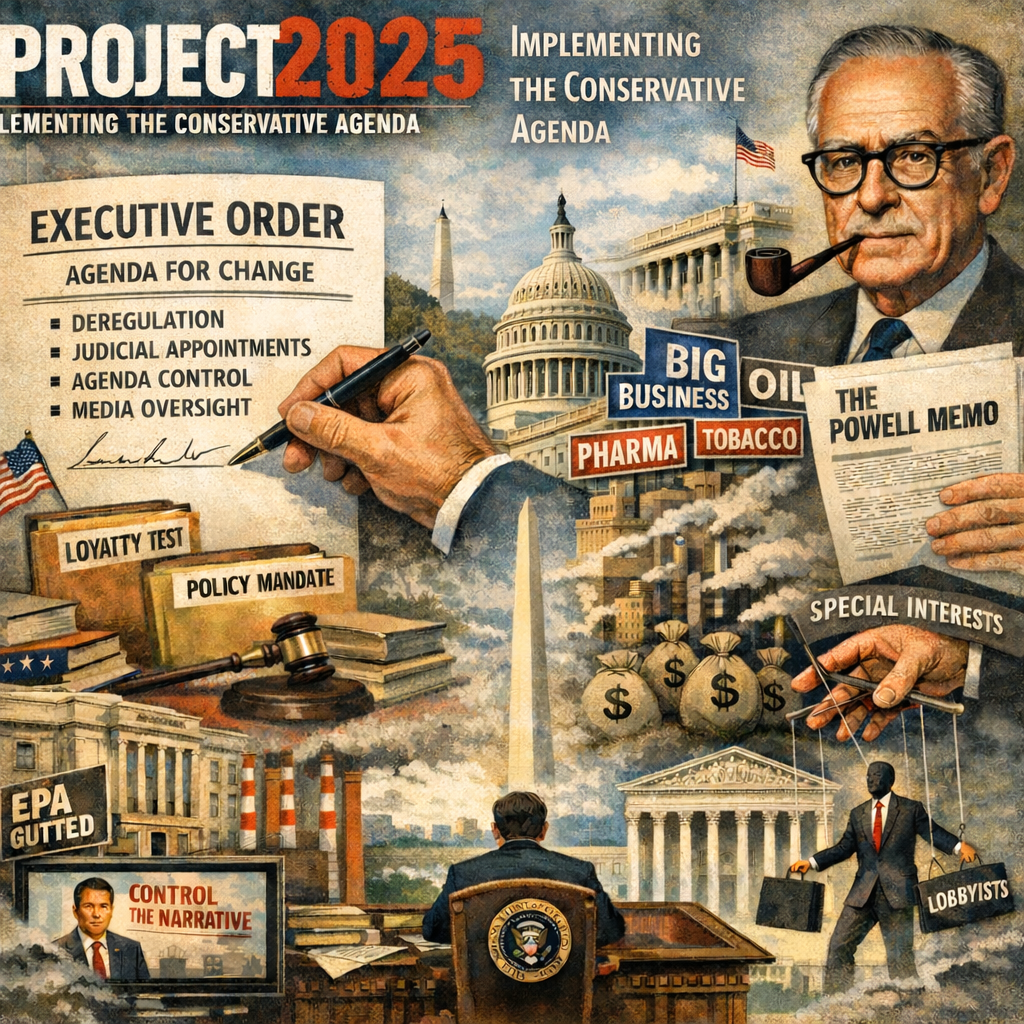
In August 1971, a corporate lawyer named Lewis Powell wrote a confidential memorandum that would quietly alter the trajectory of American politics. It was one of the highest points to the start of corporate greed and extreme meddling in public affairs. That memorandum was addressed to the US Chamber of Commerce, in which Powell warned that the “American free enterprise system” was under sustained ideological attack coming from universities, media, consumer advocates, labor unions, and reformers.
More than 50 years later, the memo reads less like a historical artifact and more like a blueprint. Its core ideas were premised on building institutions, shape public opinion, influence the courts, and embed long-term ideological infrastructure, while making these to become the backbone of modern conservative strategy.
Today, the most explicit descendant of Powell’s vision is Project 2025, a sweeping policy and personnel plan developed by the Heritage Foundation and dozens of allied organizations. It proposes a dramatic restructuring of the federal government, a consolidation of presidential power, and a roll back of regulatory and civil rights protections.
To understand why Project 2025 matters, and why it resonates far beyond the US, we need to trace the arc from Powell’s Memo to the present moment and then widen the lens to global parallels. Because the story of Powell and Project 2025 is not just an American story. It is part of a worldwide pattern in which political movements build long-term institutional machinery to reshape governance itself with inevitable global influence and ramifications.
Lewis Powell was not a firebrand. He was a corporate attorney, a board member of major companies, and soon to be a Supreme Court justice. His memo was not a public manifesto; it was a private strategy document. But its message was unmistakable.
Powell argued that:
· Business was losing the battle of ideas.
· Critics of corporate power were shaping culture and policy.
· The response needed to be organized, intellectual, and permanent.
· The battleground was not just Congress, but universities, courts, media and public discourse.
He urged the Chamber of Commerce to invest in:
· Think tanks to produce research and policy proposals.
· Legal advocacy groups to influence courts.
· Media and communications infrastructure to shape public opinion.
· Monitoring systems to track textbooks, television, and public messaging.
· Leadership pipelines to place ideologically aligned individuals in government.
Powell did not call for a political party, He called for an ecosystem that is durable, well-funded, multi-front infrastructure capable of shifting the intellectual and political climates over decades.
In hindsight, the memo was less a reaction to crisis and more a strategic roadmap, it articulated a long-term vision to reshaping American governance from the inside out.
The 1970s and 1980s saw Powell’s ideas come to life.
1. Think Tanks and Policy Shops: Organizations like the Heritage Foundation, Cato Institute, and American Enterprise Institute expanded rapidly, producing research, policy proposals, and media commentary. They became intellectual engines for conservative governance.
2. The Legal Movement: The Federalist Society emerged as a powerful network of conservative lawyers, judges, and scholars. It became the primary pipeline for judicial appointments, shaping the courts for generations.
3. Media Ecosystems: Conservative media outlets grew, amplifying messaging and creating a parallel information environment. As at the time of my writing this article, cronies of the current government are taking over most of the medial outlets including social media with the intent to be the main voice in public space.
4. The “Mandate for Leadership” Series: In 1980, Heritage published the first Mandate for Leadership, a detailed governing manual for the incoming Reagan administration. Regan officials embraced it enthusiastically, implementing a large share of its recommendations.
This was Powell’s memo operationalized as a coordinated, well-funded, long-term effort to reshape governance.
Project 2025 is the latest and the most ambitious iteration of the “Mandate for Leadership” series. It is not a campaign document. It is a governing blueprint designed to be ready for any conservative president.
Its components include:
1. A 900-Page policy Manual: Covering every major federal department, it proposes:
a. Centralizing presidential control over the bureaucracy.
b. Weakening or restructuring independent agencies.
c. Rolling back environmental, labor, and consumer protections.
d. Overhauling immigration enforcement.
e. Reshaping civil rights enforcement.
f. Reorienting education policy toward conservative cultural policies.
2. A Personnel Project: Project 2025 includes a database and training program to identify, vet and prepare thousands of ideologically aligned individuals for government roles.
3. A Strategy to “Take the Reins of Government”: The project explicitly seeks to “deconstruct the administrative state,” echoing Powell’s call to challenge regulatory and bureaucratic power.
4. A Fusion of Corporate and Cultural Agendas: Where Powell focused on corporate interests, Project 2025 blends economic deregulation with modern culture-war priorities, from reproductive rights to LGBTQ+ issues to school curricula.
Basically, Project 2025 is Powell’s memo updated for the 21st century by being more expansive, more ideological and more operational.
The alignment is clear from three dimensions.
1. Strategy – Long-term infrastructure: Powell emphasized building institutions that would shape policy for decades and was explicitly designed as a permanent governing machine, and not as a campaign tool.
2. Structure – A Coordinated Ecosystem: Powell envisioned a network of think thanks, legal groups, and medial outlets. Project 2025 is a coalition of dozens of organizations working in sync.
3. Substance – Deregulation and Power Consolidation: Powell warned against regulation and labor power. Project 2025 proposes sweeping rollbacks of regulatory authority and a restructuring of the civil service to increase political control. The difference is that Project 2025 adds a strong cultural and religious dimension that Powell never emphasized.
Donald Trump’s first term did not have Project 2025, but it did draw heavily from Heritage’s earlier “mandate” documents. Heritage itself has said the Trump administration implemented a large share of its recommendations.
1. Courts: Trump appointed three Supreme court justices and hundreds of federal judges, many aligned with the Federalist Society’s pro-business, anti-regulatory philosophy. This is the clearest realization of Powell’s legal strategy.
2. Deregulation: Trump aggressively rolled back environmental, labor, and consumer protections, echoing Powell’s call to limit regulatory power.
3. Civil Service Restructuring: Late in his term, Trump introduced “Scheduled F,” a plan to reclassify thousands of federal workers so they could be replaced with political appointees. Project 2025 proposes reviving and expanding this idea.
4. Culture-War Governance: Policies on immigration, reproductive rights, and LGBQT+ issues foreshadowed many of Project 2025’s cultural priorities.
In short, Trump’s first term was a prototype, while Project 2025 is the fully engineered version. This was the key reason why some of us rang the alarm bel on the consequences of a Trump 2.0.
Trump’s second term has already implemented a substantial portion of Project 2025’s agenda, even as he publicly distances himself from the document. Independent trackers and policy watchdogs estimate that roughly 47-50% of the domestic policy goals outlined in Project 2025 have been initiated or completed. These are in these key areas:
1. Personnel and Institutional Control: Trump has appointed several Project 2025 contributors to key roles –
a. Russell Vought – is the Project 2025 architect and now leads the Office of Management and Budget in the current government.
b. Peter Navarro – is the author of the trade section of Project 2025 and is a top trade adviser to Trump.
c. Brendan Carr – is the author of the FCC reform in the Project 2025 and now leads the Federal Communications Commission.
These placements reflect Project 2025’s strategy of embedding ideologically aligned actors across the executive branch.
2. Executive Orders and Bureaucratic Restructuring: Trump has used executive orders to –
a. End all federal DEI (Diversity, Equity, Inclusion) program: This aligned with Project 2025’s call to dismantle the “DEI apparatus.”
b. Begin Dismantling the Department of Education: This included staff cuts and functional transfers which were all core Project 2025 goals.
c. Restructure agencies like NOAA and FBI: This included moves toward politicized control and budget cuts.
The question that bothered me a lot about this is why dismantling such critical agencies and policy whose absence will take the country backwards and destroy the key foundations that led to the greatness of the US.
3. Regulatory Rollbacks and Shutdown Leverage: Trump has initiated or fulfilled 251 of 532 recommended actions across 20 federal agencies.
During the 2025 government shutdown, the administration explicitly used the crisis to advance Project 2025 goals, including:
· Downsizing the federal workforce.
· Cutting budgets for social programs, and
· Accelerating deregulatory actions.
4. Cultural and Civil Rights Retrenchment: Project 2025 calls for removing terms like “gender identity,” “reproductive rights,” and “sexual orientation” from federal rules. Trump’s administration has started purging such language from regulations and guidance documents. Also, DEI data collection and equity tracking mechanisms have been suspended or eliminated. Some of these actions were adopted by some state governments and private organizations due to lack of oversight or enforcement through the federal government.
5. Public Messaging and Strategic Denial: While Trump claims he has “nothing to do” with Project 2025, his administration’s actions closely mirror its blueprint. Many of the policy authors served in his first term and returned for the second term, thereby reinforcing the continuity.
This implementation under Trump 2.0 reflects a disciplined effort to reshape the federal government’s structure, staffing, and policy orientation, not just through legislation but through executive power and bureaucratic control. It is Powell’s memo in motion, with Project 2025 as the operational manual.
The Powell memo may be American, but its logic on building institutions, shape courts, influence bureaucracy, and consolidate executive power, has echoes around the globe.
1. Hungary – The Orban Model: Prime Minister Viktor Orban has spent more than a decade reshaping Hungary’s political system by:
a. Centralizing executive power.
b. Rewriting the constitution.
c. Restructuring the civil service.
d. Influencing Universities and media.
e. Building a network of loyalists across institutions.
This mirrors Powell’s emphasis on long-term institutional control.
2. India – Institutional Realignment Under the BJP: Under Prime Minister Narendra Modi, India has seen:
a. Increased centralization of executive authority.
b. Stronger ideological influence in education and media.
c. Shifts in judicial appointments and legal interpretations.
d. A long-term strategy to reshape national identity.
The BJP’s approach reflects Powell’s insight that cultural institutions are as important as political ones.
3. Brazil – Competing Institutional Projects: Brazil has seen competing long-term institutional strategies from both left and right:
a. The Worker’s Party built social programs and legal frameworks.
b. Conservative movements later built media and legal networks.
c. Jair Bolsonaro attempted to reshape the civil service and regulatory agencies.
Brazil illustrates how Powell-style strategies can be adopted by different ideological camps.
4. United Kingdom – Think Tanks and Deregulation: British politics has long featured powerful think tanks, from Institute of Economic Affairs to Policy Exchange, that influence policy on deregulation, privatization and governance. The UK’s “small-state” movements echo Powell’s call for business-aligned intellectual infrastructure.
5. Nigeria – Institutional Capture and Counter-Capture: Nigeria’s political landscape shows how:
a. Parties build long-term patronage networks.
b. Institutions can be reshaped by successive administrations.
c. Civil service reforms often become tools of political consolidation.
d. Media and public discourse are battlegrounds for influence.
While Nigeria’s context differs, the underlying logic which is to control institutions to shape outcomes, parallels Powell’s framework. Some of these were inherited from the previous military administrations starting with that of Murtala Muhammad who on assumption of office through a coup in 1975 dismantled the entire Federal Civil Service, controlled media, etc. These were later normalized by the government of Ibrahim Babaginda.
Across continents, the Powell strategy has become a global template: lasting political change requires lasting institutional power.
1. Scenario 1: Full Implementation: If a future administration embraces Project 2025 –
a. The civil service could be reshaped into more political workforce.
b. Regulations on environment, labor, and consumer protection cold be dramatically weakened.
c. Presidential power could expand significantly.
d. Federal policy on immigration, education, and civil rights could shift sharply.
This would represent the most complete realization of Powell’s 1971 vision. The consequence of this is already becoming apparent in terms of actions by the Trump government against civil service, extension of presidential power without respect for any judicial oversight, and government policies on environment, consumer protection, immigration, education, research and civil rights. Under this umbrella, promotion of racism has increased not just through government policies but by utterances by Trump.
2. Scenario 2: Partial Implementation: Even with political alignment, courts, Congress, and career officials could slow or block major changes. Project 2025 would still shift the policy landscape but not reform it entirely. The downside of this scenario is a high likelihood that the damage might have already occurred over the 4-year term of Trump especially to the civil service, universities, research institutes that it will take decades for things to get better.
3. Scenario 3: Backlash and Reform: Public concern about concentrated power, whether corporate, presidential, or ideological, could spark:
a. New protections for civil service independence.
b. Stronger labor and voting rights laws.
c. Greater transparency around political finding and think-tank influence.
Some of the implementations of Project 2025 are already being resisted by members of the public and this may later manifest with later elections if those elections are not tampered with.
In this scenario 3, Powell’s memo along with the Project 2025 becomes a catalyst for a countermovement. It will become lesson to ensure that such will never happen again in the history of the country.
The Powell memo was not a prophecy. It was a strategy while Project 2025 that ensued is not a destiny but a plan.
Both documents share common thread which is the belief that lasting political change comes from building institutions, shaping narratives, and influencing the machinery of government itself.
For the general public, understanding this lineage helps explain why today’s political battles feel so structural, why debates about regulation courts, civil service, and presidential power are not isolated fights but part of a long-running project.
Whether one sees Project 2025 as a necessary correction or a dangerous overreach, it is undeniably the most explicit attempt yet to carry Powell’s 1971 vision into the heart of 21st-century governance.
--------------------------------
Dr. Segun Dawodu is the owner and chief webmaster of Dawodu.com. He has a medical degree from University of Ibadan, MBA from Johns Hopkins University Carey Business School, MSc in Global Health Leadership from University of Oxford, LL.B from University of London, MS in Clinical Informatics from Northwestern University, Evanston, IL, LL.M in Medical ethics/Intellectual property law from University of London, LL.M in International Corporate and Commercial Law from Kings’ College, London, LL.M in US law from George Mason University, Postgraduate Diploma in Economics of Law/Competition Law/Antitrust Law from King’s College, London, Creative Writing Diploma from University of Pennsylvania and Associate of Kings College ( a Bachelor’s degree equivalent in Theology, Philosophy and Ethics). He is currently undergoing Ph.D (law) research in Telemedicine, AI and cross-border policy and regulations at University of London, Institute of Advanced Legal Studies.
RETURN

Is Artificial Intelligence Stupid? – Misconceptions to a Legal AlbatrossMy engagement with artificial intelligence (AI) began in 1998, when I was a ...

Wike Is Right on the Money: Nigerian Football, National Pride, and the Lost Discipline of Sports DevelopmentPreviously published on VANGUARD Newspaper...

The Blessing Has Been Given; The Stewardship Remains- A Sermon for the Thirteenth Sunday in Ordinary Time -My dear brothers and sisters in Christ,I ag...

AI Can Cross Disciplines. It Still Can’t Replace Expert Judgmentfirst published on Substack on April 28, 2026Large language models (LLMs) have becom...
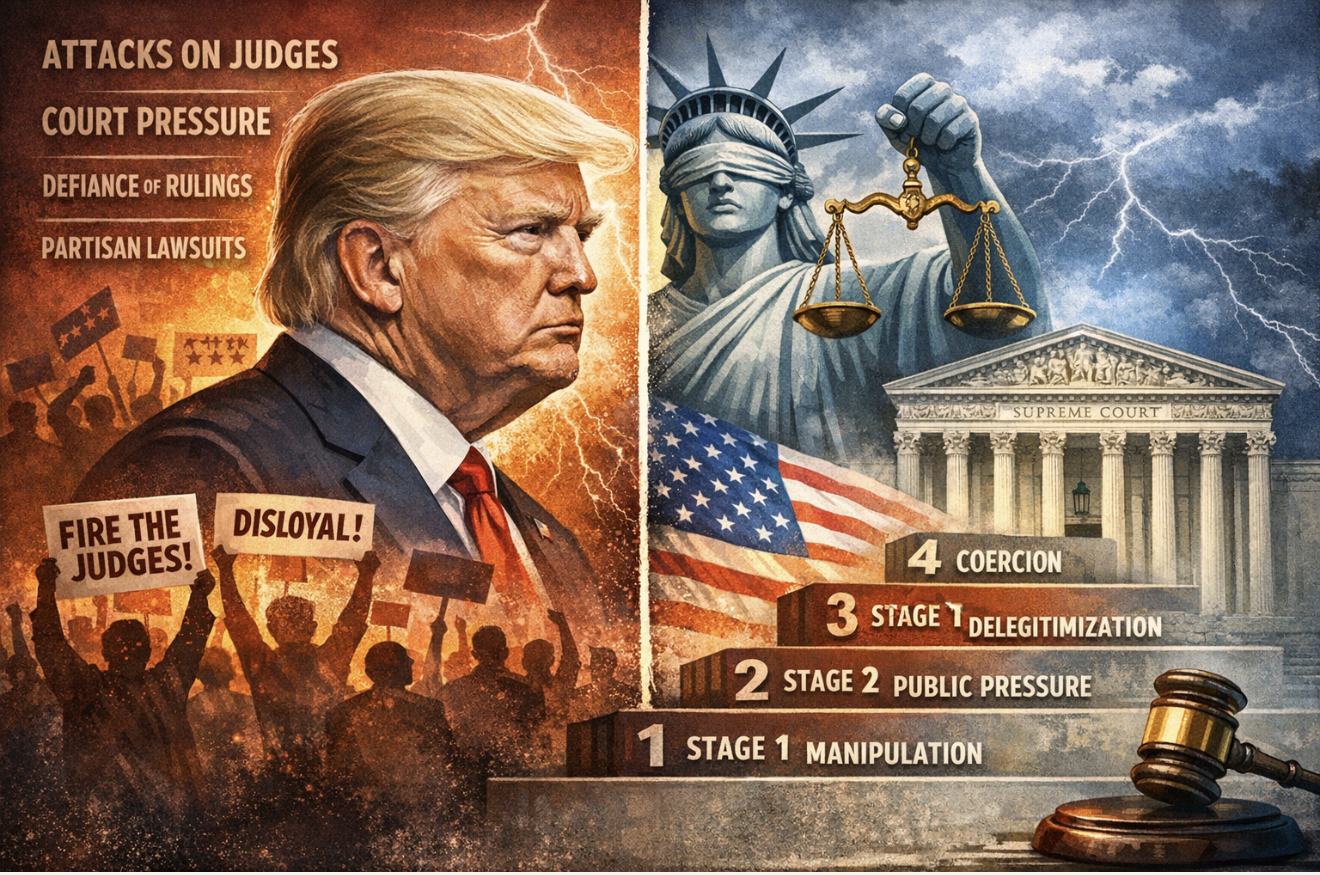
Intimidating The Judiciary: Trump and A Global History of Executive Pressure on Supreme Courts- From Washington to Berlin to Budapest, and the warning...




Social & Political Issues / Sep 19, 2026
A Death, and a Remembrance of a Time PastSocial & Political Issues / Oct 18, 2003
Abuja As A Hi-Tech Hub For Innovation, Entrepreneurship, And Knowledge ExchangeSocial & Political Issues / Jun 02, 2004
About "Security Breach" and "Coup Scare"Social & Political Issues / Oct 05, 2002
ABOUT THE NORTHERN AGENDA : "General said, Chief said, Alhaji said"Social & Political Issues / Feb 09, 2006
Abduction of Oil Workers: Matters Arising© 2026 Segun Toyin Dawodu | All rights reserved